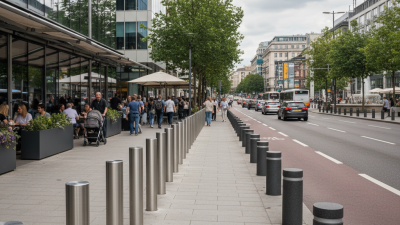
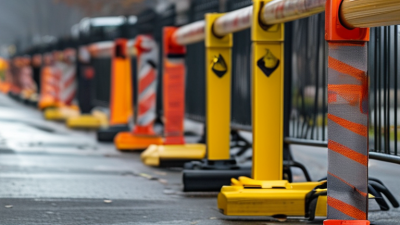
| Fixed Steel Bollard |
Permanent protection for rack ends, structural columns, dock equipment, electrical cabinets, and pedestrian separation points. |
- Common diameter: 4–6 in (100–150 mm)
- Common height: 36–48 in (900–1,200 mm)
- Schedule 40 or heavier steel pipe is frequently used
- Base plates or direct-set installation may be used
|
Install at exposed rack uprights, corners, door jambs, columns, and equipment edges where forklifts or pallet trucks may approach.
|
Anchor to sound concrete using engineered anchors. Keep the bollard outside the required aisle and pedestrian-clearance envelope. Use a protective layout that does not create a new trip hazard.
|
Provides continuous, highly visible physical protection and is suitable for high-traffic areas. |
It can obstruct maintenance access and may transfer impact forces into the slab or protected structure if not engineered correctly. |
| Surface-Mounted Steel Bollard |
Facilities where underground excavation is not practical or where bollards must be installed on an existing concrete slab. |
- Typical diameter: 4–6 in (100–150 mm)
- Typical height: 36–48 in (900–1,200 mm)
- Base plates commonly use four or more anchors
- Available with welded or bolt-on base plates
|
Place around machinery, columns, wall corners, battery-charging areas, and the outside corners of storage zones. |
Verify slab thickness, concrete strength, edge distance, and anchor capacity before drilling. Do not anchor too close to slab edges, joints, cracks, or embedded services.
|
Fast to retrofit and easier to replace than a directly embedded bollard. |
Performance depends heavily on anchor design and slab condition; damaged anchors can reduce protection. |
| Removable Steel Bollard |
Temporary access points, delivery routes, emergency access lanes, and areas requiring occasional equipment movement. |
- Typical diameter: 4–6 in (100–150 mm)
- Typical height: 36–48 in (900–1,200 mm)
- Uses sockets, locking pins, or tamper-resistant fasteners
- Often supplied with high-visibility finishes
|
Use at access openings that need protection during normal operations but must be opened for maintenance, deliveries, or emergency response. |
Install receiving sockets flush and clearly mark the opening. Store removed bollards safely so they do not enter forklift or pedestrian travel paths.
|
Combines impact protection with operational flexibility. |
Protection is reduced whenever the bollard is removed, unlocked, or incorrectly reinstalled. |
| Retractable or Folding Bollard |
Controlled-access doors, loading areas, aisle transitions, and locations where clearance is needed at selected times. |
- Typical diameter: 4–6 in (100–150 mm)
- Typical height: approximately 36–42 in (900–1,050 mm)
- Manual, spring-assisted, or lockable designs are available
- Usually surface-mounted or socket-mounted
|
Position outside door swings, dock approaches, vehicle turning paths, and marked pedestrian crossings. |
Confirm that the raised or folded position does not reduce aisle width or create a protrusion. Use positive locking and inspect hinges, pins, and mounting points regularly.
|
Allows a protected route to be opened without removing and storing a separate barrier. |
Moving components require regular inspection and may provide less protection than a properly engineered fixed system. |
| Flexible Polymer Bollard |
Low-to-moderate speed guidance, aisle delineation, pedestrian route marking, and locations where occasional contact is expected. |
- Typical diameter: 3–6 in (75–150 mm)
- Typical height: 36–48 in (900–1,200 mm)
- Made from flexible polyurethane or similar resilient material
- Often includes reflective bands or bright colors
|
Use along pedestrian walkways, aisle entrances, column lines, and corners where visibility is more important than heavy-impact resistance. |
Attach to a suitable concrete surface and maintain a clear recovery area around the flexible post. Replace units that remain permanently bent, cracked, or detached.
|
Improves visibility and can reduce damage from light contact with vehicles or carts. |
Not normally suitable as the only barrier for high-energy forklift impacts, dock edges, or critical structural assets. |
| Heavy-Duty Impact-Rated Bollard |
High-risk forklift routes, rack-end protection, dock doors, fuel or battery areas, fire-protection equipment, and vulnerable building services. |
- Common diameter: 6–8 in (150–200 mm) or larger
- Typical height: 42–48 in (1,050–1,200 mm)
- May use reinforced steel, engineered bases, or energy-absorbing systems
- Performance should be supported by documented impact testing or engineering calculations
|
Install where vehicle mass, speed, turning behavior, and asset criticality create a high potential for serious damage. |
Select the system using the expected vehicle weight and speed, impact angle, anchorage, slab capacity, and required clearance. Follow the manufacturer's or engineer's tested installation details.
|
Offers a higher level of protection when correctly selected and installed for the actual traffic conditions. |
Higher cost, greater space requirements, and potentially significant forces transferred to the slab or adjacent structure. |
| Rack-End Guard System |
Protection for the exposed ends of pallet-rack frames and nearby aisle corners. |
- Common height: 12–48 in (300–1,200 mm), depending on design
- Steel guards may use plate, angle, tube, or formed sections
- Some systems surround the upright rather than using a single post
- Configuration should match rack geometry and pallet overhang
|
Place at every exposed rack end facing a forklift aisle, especially at aisle intersections and turning points. |
Maintain access to rack anchors, do not block sprinkler discharge patterns, and inspect the rack frame after any significant impact. Replace bent or displaced components promptly.
|
Protects rack uprights at the point where forklift collisions commonly occur. |
It does not replace rack anchoring, load-limit controls, aisle management, or regular rack inspections. |
| Bollard-and-Rail Barrier |
Continuous separation between forklifts and pedestrians, workstations, offices, packing areas, or high-value equipment. |
- Typical bollard height: 36–48 in (900–1,200 mm)
- Rail height commonly includes one or more horizontal members
- Post spacing is determined by the barrier design and impact loads
- Steel or engineered modular systems are available
|
Use along long pedestrian routes, around work cells, beside conveyor lines, and at the perimeter of charging or processing areas. |
Provide controlled openings with adequate gate protection. Keep the barrier outside required escape paths and ensure rails cannot be mistaken for handrails unless designed for that purpose.
|
Creates a continuous physical boundary rather than protecting only isolated points. |
Requires more floor space and careful gate, egress, housekeeping, and emergency-access planning. |
| Dock and Door Protection Bollard |
Loading-dock doors, leveler controls, dock bumpers, overhead doors, pedestrian doors, and wall-mounted controls. |
- Typical diameter: 4–8 in (100–200 mm)
- Typical height: 36–48 in (900–1,200 mm)
- May include offset, U-shaped, or goal-post configurations
- High-visibility yellow or contrasting finishes are commonly used
|
Place on both sides of vulnerable doors or controls while maintaining the required opening width and dock operating clearance. |
Coordinate placement with trailer swing, dock leveler movement, dock plates, wheel chocks, and pedestrian access. Never obstruct emergency exits or equipment controls.
|
Reduces damage to doors, controls, walls, and dock infrastructure from reversing vehicles and material-handling equipment. |
Incorrect placement can interfere with trailer loading, door operation, or emergency evacuation. |
| High-Visibility Safety Bollard |
Marking hazards, aisle boundaries, crossing points, fire-equipment locations, and low-visibility corners. |
- Typical height: 36–48 in (900–1,200 mm)
- Common finishes: safety yellow, orange, or contrasting colors
- Reflective bands are useful in low-light areas
- May be steel, polymer, or composite construction
|
Place at eye-catching locations before hazards, at aisle approaches, and near corners where forklift operators need additional visual cues. |
Use consistent colors and markings throughout the facility. Keep surfaces clean and replace faded reflective material. Do not rely on visibility alone where a physical barrier is required.
|
Improves recognition of hazards and helps separate vehicle and pedestrian movements. |
Color and reflectivity do not provide sufficient impact protection without suitable structural design. |